SAM registration provides the foundation for FAR and DFARS compliance in federal contracting. Contractors must maintain active registration to guarantee eligibility for contracts, timely payments, and regulatory adherence. Compliance strategies include integrating SAM profiles with internal processes, automating regulatory tracking, and implementing specialized tools for DCAA and NIST requirements. Regular audits and centralized documentation prevent compliance lapses that could result in contract loss or penalties. The proper infrastructure connects SAM data with thorough compliance systems for long-term success.
The Critical Connection Between SAM Registration and Federal Contract Compliance

When pursuing federal contracts, businesses must establish a strong foundation through proper System for Award Management (SAM) registration. This registration process serves as the gateway to federal contracting opportunities, providing essential compliance with Federal Acquisition Regulations (FAR).
The SAM registration benefits extend beyond mere regulatory adherence. Companies gain competitive advantage, guarantee timely payments, and validate their legitimacy as federal contractors. Throughout the contract lifecycle, active registration enables prompt payment processing and continued eligibility for awards.
Compliance challenges often arise when contractors fail to maintain current SAM registrations. Lapsed registrations can result in contract ineligibility, payment delays, and potential regulatory penalties. A valid Unique Entity Identifier is mandatory for all businesses seeking to participate in the federal contracting process.
Successful contractors implement regular registration updates and continuous monitoring of changing federal requirements to maintain their standing in the federal marketplace. Recent case law indicates that contractors must maintain continuous registration from the submission of their final proposal through contract performance until final payment is received.
Navigating the Complex Landscape of FAR and DFARS Requirements

Federal contractors face significant challenges as they navigate the intricate regulatory environment established by the Federal Acquisition Regulation (FAR) and Defense Federal Acquisition Regulation Supplement (DFARS). The regulations undergo periodic FAR amendments and DFARS updates, requiring contractors to maintain vigilant compliance monitoring systems.
For DoD contractors, special attention must be paid to critical cybersecurity clauses like DFARS 252.204-7012, which mandates protection of Controlled Unclassified Information using NIST SP 800-171 controls. Just as systems may encounter CSS errors that interrupt user experiences, compliance lapses can similarly disrupt contractor operations. Similar to how users experience frustration when encountering technical issues, contractors often struggle with the complexity of regulatory requirements.
In addition, contractors must comply with DFARS 252.204-7019 and 252.204-7020 by conducting self-assessments and maintaining compliance records in the Supplier Performance Risk System.
These requirements directly impact business opportunities, as non-compliance can result in contract loss and reputational damage.
Successful navigation of these regulations often requires specialized resources and ongoing investment in cybersecurity infrastructure.
Implementing Effective Strategies for Ongoing Regulatory Adherence
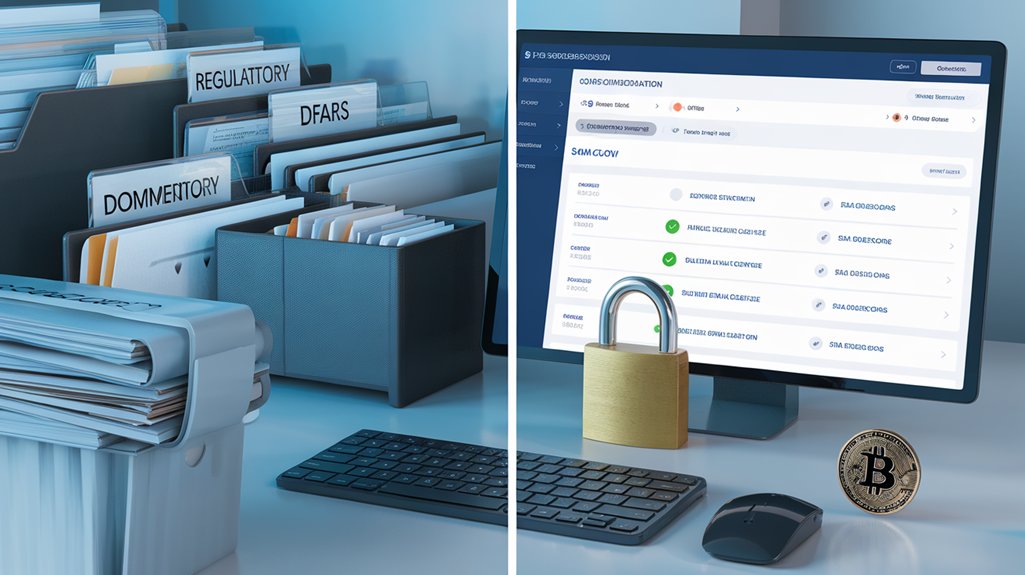
Successful contractors establish integrated compliance systems that connect their System for Award Management (SAM) profiles with internal processes to maintain FAR and DFARS adherence. These systems automate the tracking of regulatory frameworks, enabling real-time alerts when critical updates affect SAM-registered contracts.
Effective compliance technologies include SAM-synced DCAA tools that guarantee adherence to FAR Part 31 cost principles and centralized documentation repositories that maintain audit trails.
Organizations implement NIST SP 800-171 monitoring dashboards linked to SAM data for continuous cybersecurity alignment. Regular compliance audits help identify potential issues and ensure competitive advantage in the defense contracting ecosystem. Companies must also establish robust incident response protocols to address security breaches as required by DFARS regulations.
Leading contractors also utilize SAM-based certification tracking for employees handling CUI and integrate compliance checklists into workflows for FAR 52.204-21 requirements. This systematic approach creates defensible documentation while streamlining subcontractor oversight through SAM data validation.
Frequently Asked Questions
How Long Does the SAM Registration Process Typically Take?
The SAM registration process typically takes 7 to 10 business days for approval after submission.
Processing times can vary based on several factors, including business complexity, validation issues, and whether proper documentation is provided.
Companies lacking an EIN or TIN may experience additional delays, as obtaining these identifiers from the IRS could add up to five weeks to the timeline.
Recent system updates to SAM.gov have reportedly extended processing times for some users.
Can Subcontractors Avoid SAM Registration Requirements?
Yes, subcontractors typically can avoid SAM registration requirements.
Under standard federal contracting regulations, subcontractor obligations generally do not include mandatory SAM registration unless specifically required by the prime contract or program.
Notable registration exemptions exist for most subcontractors, though they may still need to obtain a Unique Entity Identifier (UEI) and undergo debarment checks.
Prime contractors remain responsible for verifying their subcontractors are not excluded parties, even when subcontractors are exempt from SAM registration.
What Penalties Exist for Far/Dfars Non-Compliance?
Non-compliance penalties for FAR violations range from contractual to legal consequences.
Contractors may face contract termination, substantial fines, or removal and replacement requirements for unauthorized materials.
More severe cases can trigger suspension or debarment from future government contracts.
DFARS violations specifically may result in disqualification from DoD contracts, stop-work orders, and mandatory cybersecurity remediation.
Companies may also suffer reputational damage, affecting future business opportunities throughout the federal contracting ecosystem.
How Frequently Must NIST 800-171 Assessments Be Updated?
NIST 800-171 assessments must be updated at least every three years per contractual obligations.
However, organizations must also update these assessments whenever significant changes occur in the CUI environment or control implementations.
The compliance frequency requirements include immediate reassessment outside formal cycles when system changes occur.
Additionally, DoD medium and high assessments may trigger more frequent reviews, and NIST revision updates (such as Revision 3) may necessitate updates before the standard three-year window expires.
Are Small Businesses Exempt From Certain Compliance Requirements?
Small businesses enjoy several compliance requirement exemptions across federal contracting regulations. They are typically exempt from Cost Accounting Standards when under threshold requirements and often excluded from DFARS 252.242-7005 business system rules.
These small business exemptions acknowledge resource limitations smaller companies face. Additionally, small businesses benefit from set-aside programs that prioritize their participation without requiring full DFARS compliance.
However, exemptions vary by contract type and size, making it essential for small businesses to verify specific requirements for each opportunity.