SBA size standards in SAM determine eligibility for government contracting programs based on NAICS codes. Businesses must meet specific thresholds of either annual receipts (calculated as a three-year average) or employee count for their primary industry. Common compliance issues include incorrect NAICS selection, undisclosed affiliations, and outdated SAM profiles. Regular profile updates and accurate documentation are essential to maintain small business status. Proper understanding of these standards prevents disqualification during competitive bidding processes.
How NAICS Codes Determine Your SBA Size Classification
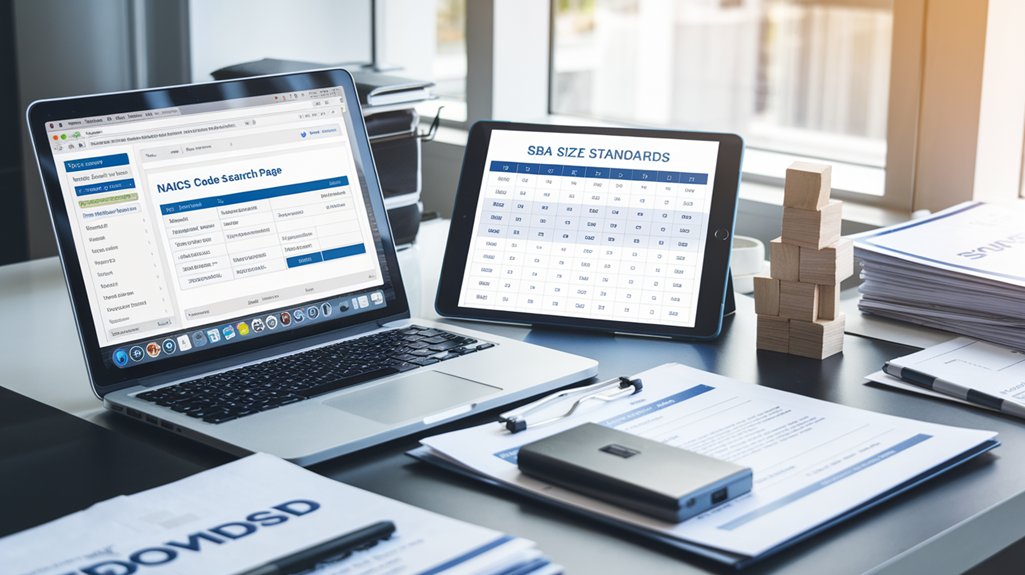
The North American Industry Classification System (NAICS) serves as the foundation for how the Small Business Administration (SBA) classifies businesses as “small” or not. These codes are essential for establishing industry-specific size standards that determine federal contracting eligibility and program participation.
The SBA takes an industry-by-industry approach, creating unique size standards for each NAICS code based on either annual receipts or employee count. This NAICS impact extends throughout the federal contracting ecosystem, as businesses must meet the size standard for their specific code to qualify as small.
Industry classification through NAICS enables the SBA to evaluate market-specific data when setting appropriate thresholds, ensuring that standards accurately reflect each sector’s competitive landscape. When NAICS codes update every five years, the SBA adjusts size standards accordingly. Incorrect NAICS selection during SAM registration can significantly limit a small business’s opportunities to compete for government contracts in their relevant industry sectors.
Calculating Business Size: The Three-Year Revenue Method

Traditionally, small businesses seeking SBA program eligibility must calculate their size using a three-year revenue averaging method, which remains the standard approach for SBA Business Loan Programs, Disaster Loan Programs, Surety Bond Programs, and SBIC Programs.
This calculation involves adding gross receipts from the three most recently completed fiscal years and dividing by three.
For newer businesses operating less than three years, the SBA allows annualizing revenue by multiplying average weekly revenue by 52.
The revenue calculation follows specific guidelines outlined in 13 CFR 121.104, excluding passive income and certain non-operational funds.
Businesses must maintain good standing with the IRS to ensure continued eligibility for federal programs through SAM registration.
While a five-year revenue averaging period was introduced in 2020 for many SBA programs, the three-year method continues to be essential for proper business classification in loan programs and during the established shift period. The SBA has implemented a transition period until January 6, 2022, during which businesses can choose to continue using the three-year average calculation method.
Common Size Standard Compliance Pitfalls to Avoid

While maneuvering SBA size standards appears straightforward, businesses routinely encounter serious compliance pitfalls that threaten their eligibility and create substantial legal exposure.
Among the most dangerous are affiliation risks, where companies fail to properly disclose relationships with joint ventures, family-owned enterprises, or upstream ownership structures that could trigger size standard violations.
Affiliation issues remain the silent killer of small business status when connections go undisclosed and trigger unexpected size violations.
Documentation errors represent another critical vulnerability area. Outdated SAM.gov profiles, unsigned certifications, inconsistent representations across proposals, and missing financial records frequently lead to disqualification during competitive bidding. Regular SAM profile updates are necessary to maintain compliance and prevent potential disqualification from federal contracting opportunities. The SBA sets industry-specific thresholds that typically limit small businesses to 500 employees or $7.5 million in receipts, with numerous variations. SAM’s consolidated system has significantly reduced administrative burdens for small businesses seeking to navigate the complex federal procurement landscape.
These issues often surface during size protests, triggering SBA investigations that can reveal deeper compliance failures.
Contractors must also remain vigilant about NAICS code-specific thresholds and implement corrective action plans immediately following adverse size determinations to avoid debarment or False Claims Act liabilities.
Frequently Asked Questions
Can My Company Qualify for Multiple NAICS Codes Simultaneously?
Companies can qualify for multiple NAICS classifications simultaneously. Most government registration systems, including SAM, allow businesses to select multiple codes that accurately represent their diverse operations.
Each NAICS code has specific size standards determined by the SBA, requiring companies to meet the criteria for each classification they claim.
Businesses should verify all selected codes genuinely reflect their activities, as misrepresentation could lead to compliance issues or disqualification from contract opportunities that require specific industry expertise.
How Do Recent Mergers Affect My Company’s Size Determination?
Recent mergers directly impact a company’s size determination for government contracting purposes.
When a merger occurs, size recalculation becomes mandatory, potentially changing the firm’s small business status.
Companies must recertify their size status after mergers or acquisitions, particularly if the transaction results in the business exceeding applicable size standards.
Following recertification, a formerly small business may lose eligibility for small business set-aside contracts and future opportunities under multiple award contracts.
When Should I Update My Size Status in SAM?
Businesses should update their size status in SAM:
- Immediately after the March 17, 2023 standards became effective
- When business growth exceeds size thresholds
- Following mergers or acquisitions that affect employee count or revenue
- When changing industry classifications or NAICS codes
- After contract modifications requiring re-representation
- During annual review of revenue fluctuations
The recommended update frequency is at least annually, but updates should occur whenever business circumstances change that affect size eligibility.
Are There Exceptions to Standard SBA Size Calculations?
Yes, several size exceptions and unique calculations exist in SBA size standards.
Industry-specific variations apply based on NAICS codes, with manufacturing and non-manufacturing sectors having different thresholds.
Special rules govern affiliate businesses, requiring aggregate calculations across controlled entities.
Contract-specific adjustments apply to certain set-asides and programs like SBIR/STTR.
Additionally, exclusions exist for agricultural operations, nonprofits, foreign-owned businesses, and certain types of employees and revenue sources.
How Do International Operations Factor Into SBA Size Standards?
International operations fully factor into SBA size standards.
All international revenue must be included when calculating a company’s size for SBA purposes, with no exemptions for overseas earnings.
Foreign subsidiaries controlled by the business are considered affiliated entities and must be counted in size calculations.
Companies must convert foreign currency to USD and include all global operations when determining if they meet small business thresholds.
This applies regardless of where revenue is generated or employees are located.